
Understanding Titration in Trauma-Informed Breathwork: A Gentle Path to Healing

Source: Yoann Boyer
In recent years, breathwork has become an increasingly popular tool for healing, self-exploration, and nervous system regulation. Many people are drawn to its ability to unlock emotions, release tension, and create profound inner shifts. However, not all breathwork approaches are created with the same level of care, especially when it comes to working with the nervous system and trauma.
In trauma-informed spaces, the focus is not on intensity or pushing for deep emotional release. Instead, it is on creating safety, building trust, and allowing the body to move at a pace it can truly integrate. This is where the concept of titration becomes essential.
Titration offers a more sustainable and grounded approach to healing - one that honors the body’s natural capacity rather than overwhelming it. Instead of diving into intense experiences, it invites gradual exploration, helping individuals stay connected to themselves throughout the process.
In this article, we will explore what titration means within the context of trauma-informed breathwork and why it plays such a critical role in safe and effective facilitation. We will look at how the nervous system responds to intensity, and how concepts like the ‘Window of Tolerance’ help us understand the importance of pacing. Finally, we will explore what titration looks like in practice and how this approach supports long-term regulation, resilience, and a deeper sense of safety in the body.
What Is Titration in Trauma-Informed Breathwork?
Titration in trauma-informed breathwork refers to the practice of approaching intensity in small, manageable amounts, rather than overwhelming the nervous system with too much sensation or emotion at once. The term comes from Somatic Experiencing, developed by Peter Levine, where healing is understood as a gradual process of building capacity—not forcing release.
In the context of breathwork, titration means slowing down the process. Instead of guiding someone into continuous, intense breathing patterns that may trigger strong emotional or physical responses, a facilitator introduces activation gently and in stages. This might look like shorter breathing cycles, pauses between rounds, or inviting awareness of subtle sensations in the body.
The intention is not to avoid depth, but to approach it in a way that feels safe and integrable. When the body is given time to process what arises, it is less likely to move into overwhelm, shutdown, or dissociation. This allows individuals to stay connected to their experience, rather than being swept away by it.
Titration also supports a sense of agency and choice. Rather than something happening to the person, they remain actively engaged in their own process; able to adjust, pause, or stop as needed. Over time, this builds trust in the body and increases the capacity to be with more sensation without losing stability.
In this way, titration becomes a foundation of trauma-informed breathwork. It shifts the focus from intensity and catharsis to safety, awareness, and sustainable healing.
Why Titration Is Essential for Nervous System Safety
The nervous system is constantly assessing whether we are safe or under threat. In trauma-informed breathwork, this matters deeply because even well-intentioned practices can be perceived by the body as overwhelming if they move too fast or too intensely.
Titration is essential because it helps keep the body within a range of safety and regulation, often referred to as the ‘Window of Tolerance’. Within this window, a person can feel, process, and stay present at the same time. Outside of it, the nervous system may shift into survival responses such as anxiety, hyperactivation, shutdown, or dissociation.
Titration works by introducing activation in small, controlled doses, allowing the nervous system to process each layer before moving further. This gradual approach supports regulation rather than reactivity. It gives the body time to settle, reorganize, and return to a sense of safety after each wave of sensation or emotion.
Over time, this process helps to expand the nervous system’s capacity. Instead of avoiding intensity altogether or being flooded by it, individuals learn how to stay present with increasing levels of sensation while still feeling grounded. This is what makes healing sustainable.
Ultimately, titration is about protecting the integrity of the nervous system. By respecting the body’s pace, it creates the conditions where real, lasting healing can occur.
Titration and Safety
Titration is a core safety principle in trauma-informed breathwork. When facilitators guide participants straight into high-intensity breathing without preparation, it can overwhelm the nervous system and potentially lead to anxiety, dissociation, or loss of control. What may feel powerful in the moment is not always safe or integrative for the person experiencing it.
A skilled facilitator approaches safety differently
Rather than pushing intensity, they begin by teaching participants how to regulate their own experience. This includes helping breathers develop awareness of their internal state such as noticing changes in sensation, emotion, or activation levels and recognizing when something feels like “too much.”
Equally important is knowing how to come back to regulation. Participants are guided in simple, practical tools they can use at any point during a session, such as:
Slowing down or softening the breath
Opening the eyes to reorient to the present moment
Moving the body to reconnect physically and reduce overwhelm
These tools help reconnect the mind and body, allowing the person to stay grounded and in control of their experience.
The goal is not to avoid intensity altogether, but to ensure that participants have the skills to navigate it safely. Grounding becomes an essential part of the practice, something that empowers individuals to regulate themselves, rather than depend entirely on the facilitator.
This is especially important because some people are naturally drawn to high-intensity experiences. Without proper guidance, they may push themselves too far. In this context, titration acts like learning to use the brakes in a car. It’s not about stopping the journey, but about having the ability to slow down when needed, so the experience remains safe, controlled, and sustainable.
How the Window of Tolerance Shapes Breathwork Practice
The concept of the ‘Window of Tolerance’ developed by Dr. Dan Siegel, offers a foundational framework for understanding how and why breathwork should be guided especially in trauma-informed settings. It describes the optimal zone in which a person can stay present, process emotions, and respond to experiences without becoming overwhelmed.
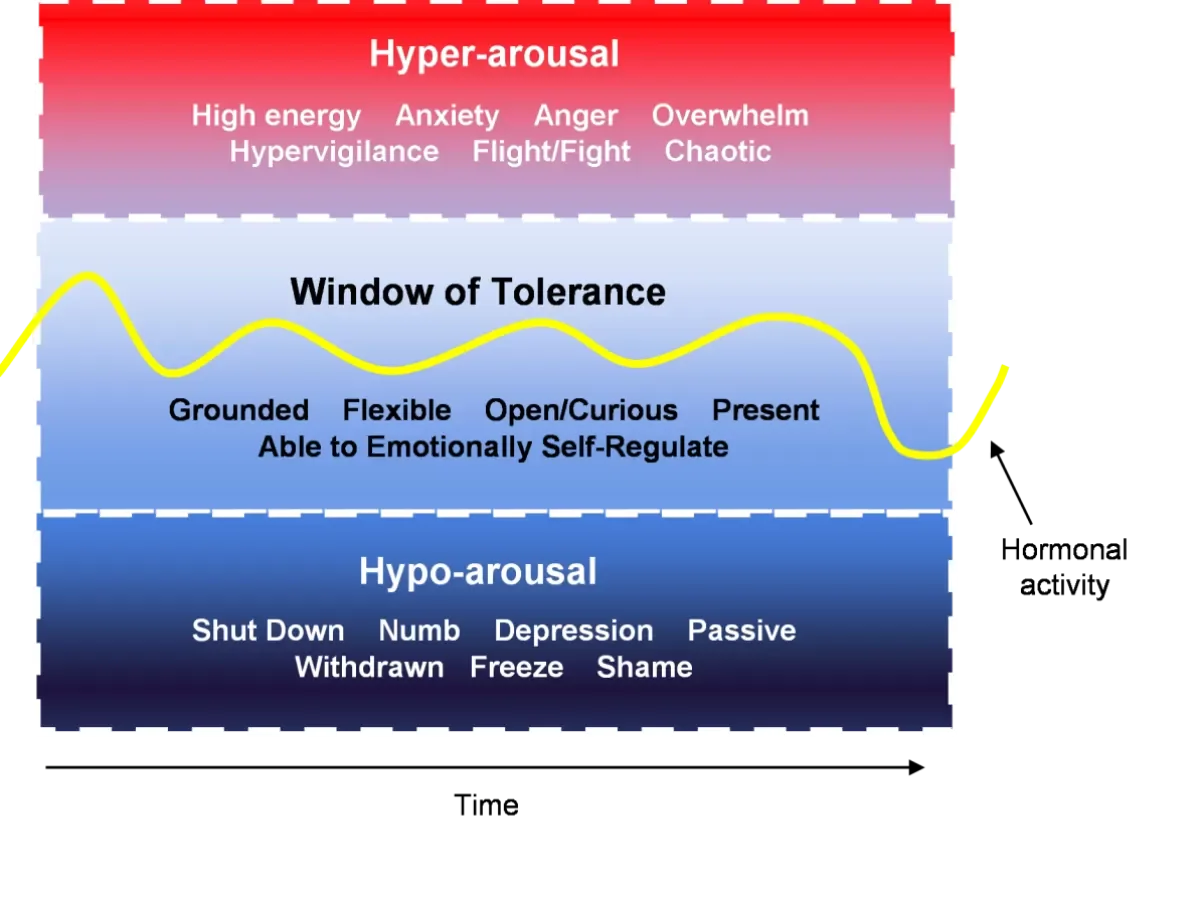
Source: Jade Emery
When someone is within this window, emotions can move through the body like waves, rising and falling naturally without becoming too intense to handle. However, when intensity exceeds this capacity, the nervous system shifts into survival states. This can show up as hyperarousal (anxiety, panic, overwhelm) or hypoarousal (numbness, shutdown, dissociation), both of which make it difficult to stay connected to the present moment or continue the healing process.
Trauma often narrows this window, meaning even small triggers can push someone into these states. The role of trauma-informed practices is not to push intensity, but to support individuals in staying within, or gently returning to, a range where experience can be processed safely.
Rethinking “Tolerance” as Capacity
While the model is useful, the language of “tolerance” can be limiting.
The word itself suggests that the goal is to “tolerate more” to endure greater intensity or discomfort. This framing can unintentionally mirror broader cultural narratives that value endurance, resilience, and pushing through, even at the cost of the body’s signals.
An alternative framing is capacity.
Rather than asking, “How much can I tolerate?”, the question becomes; “How much can I stay present with, while still feeling connected and supported?”
Capacity is not about forcing ourselves to handle more, but it is about expanding our ability to be with experience without losing connection to ourselves. In this sense, it is not necessarily helpful to have a high “tolerance” for everything. In many ways, a lower tolerance for overwhelm, disconnection, or harm is protective.
From Regulation to Returning to Resource
Similarly, the concept of “regulation” is also worth examining.
In many contexts, regulation is associated with being calm, controlled, or composed. These states are often socially rewarded, and can reflect underlying cultural norms that prioritise subdued, manageable emotional expression.
However, this framing can unintentionally position certain emotions such as rage, grief, or intensity as something to fix, reduce, or move away from.
A trauma-informed alternative is the idea of returning to resource.
Rather than seeking to become “regulated,” the focus shifts to:
staying connected to oneself
having access to support (internal or external)
being able to move through emotional states without losing grounding
This perspective recognises that emotions like anger or rage are not inherently dysregulated - they can be valid, protective, and necessary responses.
Returning to resource does not mean calming down at all costs but having enough support and connection to be with what is present, without being overwhelmed or disconnected.
What Titration Looks Like in a Breathwork Session
In practice, titration in a breathwork session is less about a specific technique and more about how the session is guided. It is an approach rooted in pacing, awareness, and responsiveness to the individual’s nervous system.
Rather than moving quickly into intense or continuous breathing patterns, a titrated session begins gently. The facilitator may guide slower, shorter breathing cycles, allowing the body to gradually build sensation without becoming overwhelmed. Periods of activation are often followed by pauses or moments of stillness, giving the nervous system time to process and settle.
A key element of titration is tracking both by the facilitator and the participant. This means noticing subtle changes in the body, such as shifts in breath, tension, temperature, or emotional tone. If activation begins to increase too quickly, the facilitator may invite the person to slow down, return to natural breathing, or bring attention to grounding sensations.
Titration also involves working at the edge of comfort without crossing into overwhelm. This might look like:
Briefly exploring a sensation or emotion, then returning to a place of safety
Alternating between activation and regulation
Giving the participant choice to pause, adjust, or stop at any time
Importantly, titration supports agency. The participant is not being pushed into an experience but is actively engaged in it, with permission to follow their own pace. This helps build trust in the body and reduces the likelihood of dissociation or shutdown.
From the outside, a titrated breathwork session may appear slower or less intense than other approaches. However, this pacing is intentional. It allows the body to integrate each layer of experience as it arises, rather than accumulating unprocessed intensity.
Over time, this way of working can gently expand a person’s capacity to feel, stay present, and regulate - making the process of healing more stable and sustainable.
The Benefits of Titration for Long-Term Healing and Integration
Titration supports a form of healing that is gradual, sustainable, and deeply integrative. By working with the body in small, manageable increments, it allows experiences to be processed without overwhelming the nervous system.
This approach helps build nervous system capacity, making it easier to stay present with sensations and emotions over time. It also reduces the risk of retraumatization by keeping the body within a range of safety, often referred to as the Window of Tolerance.
Another key benefit is the development of trust and agency. Instead of relying on intensity, individuals learn to move at their own pace, building confidence in their ability to navigate their inner experience.
Because the process is not overwhelming, the effects of breathwork are more likely to carry into daily life, supporting long-term regulation, resilience, and connection to the body.
Closing
Titration reminds us that healing does not need to be forceful to be effective. In trauma-informed breathwork, it is often the slow, steady, and attuned approach that creates the deepest transformation.
By honoring the body’s pace and capacity, titration offers a path that is not only safer, but more sustainable, empowering, and aligned with long-term healing. Try our Free Guided Breathwork as a first step of your healing journey, access here.

