
How to Calm the Nervous System with Breath

Photo by Markus Spiske
Quick Answer
The fastest way to calm your nervous system through breath: make your exhale longer than your inhale. This activates the parasympathetic ("rest and digest") branch of the nervous system via the vagus nerve, measurably slowing heart rate within a few breath cycles. A simple version to try right now: inhale for 4, hold for 7, exhale for 8, repeated 3-4 times. Full explanation of why this works, and a caution about who should approach breath-holding patterns carefully, below.
Many of us experience stress, anxiety, or overwhelm and assume it's something to fix as quickly as possible. In my work with clients, one of the more useful reframes is this: these responses aren't random. They're tightly connected to how the nervous system is functioning in that moment - and one of the most direct levers on that system is breath. This article covers how breathing patterns shape the body's stress response, why slowing the breath especifically signals safety to the nervous system, and a simple technique you can use the next time you notice yourself activated.
What the Nervous System Is, and Why It Needs Regulation
The nervous system is the body's communication network - the brain, spinal cord, and the web of nerves running through the entire body, constantly sending and receiving signals.
A key piece of that network is the Autonomic Nervous System (ANS), which governs functions we don't consciously control like heart rate, digestion, breathing rate through two complementary branches:
Sympathetic, prepares the body for action and stress.
Parasympathetic, supports rest, recovery, and restoration.
Between them, these branches keep the body in balance, shifting toward one or the other depending on what the nervous system perceives as needed in the moment.
The Question Underneath Every Stress Response
If I had to boil down what the nervous system is actually doing at any given moment, it's continuously running one question: am I safe right now?
When the answer reads as "yes," the body rests, digests, and repairs; breath deepens, muscles soften, and things feel more open. When the answer reads as "no", whether the threat is physical or emotional, real or perceived, the body shifts into protection: heart rate rises, breath goes shallow, muscles brace.
That system evolved to answer the question quickly and then stand down. The issue in modern life isn't that the system activates, it's that chronic stress, constant stimulation, and emotional overwhelm keep it answering "no" far more often than it was built for, without much recovery time in between.
Regulation, in this context, is about supporting the body back out of that holding pattern and into a state where it can actually rest and respond flexibly, rather than staying braced indefinitely. One of the most direct ways to support that shift is through breath.
How Breathing Actually Affects the Nervous System
Breathing isn't only a mechanical gas exchange. Controlled breathing has been shown to directly influence autonomic nervous system activity, reducing heart rate and stress hormone levels, meaning the rhythm of a breath is, in effect, a message the body is sending itself.
Fast, shallow breathing tends to activate the sympathetic branch with heart rate climbs, the body tenses, and the system moves toward a stress response. Slowing the breath, and specifically lengthening the exhale, activates the parasympathetic branch instead, largely via the vagus nerve, the primary pathway connecting brainstem to heart, lungs, and gut. As that system engages, heart rate slows and muscles soften.
There's also a natural breath-heart coupling worth knowing about: heart rate tends to rise slightly on the inhale and fall on the exhale - a pattern called respiratory sinus arrhythmia, one of the body's built-in, moment-to-moment regulation mechanisms.
What makes breath a uniquely useful lever here is that it's the rare bodily process that's both automatic and consciously overridable. You can't directly tell your heart rate to drop or your nervous system to relax, but you can change how you breathe, and the rest tends to follow.
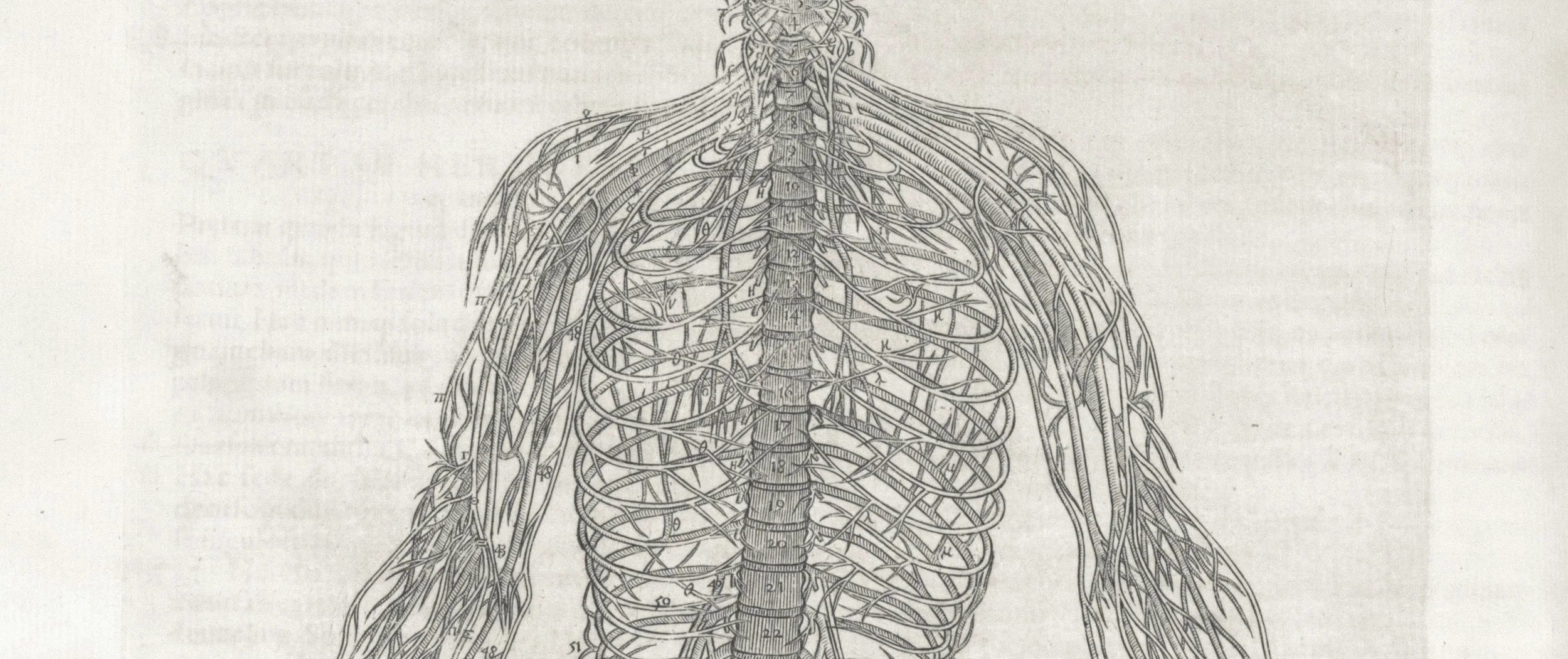
Image by The New York Public Library
Signs of Nervous System Dysregulation
Dysregulation doesn't always look dramatic. In my experience, it more often shows up as:
A constant, low-grade sense of urgency
Feeling perpetually braced for what's next• Overactive or looping thoughts
Physical tension held in the chest, shoulders, or jaw
If breath and nervous system state are this tightly linked, then the pace of breath matters as much as the fact of breathing at all, which is exactly why slowing it down, deliberately, is a real intervention and not just a relaxation cliché.
Why the Exhale Specifically Matters
Lengthening the exhale increases parasympathetic activity via the vagus nerve, which helps slow the heart rate and signal safety to the rest of the body. It's worth being precise about what this is and isn't: you're not forcing the body to calm down, you're reinforcing a rhythm it already recognises as safe. That distinction matters in practice, because approaching breathwork as a fight against your own physiology tends to backfire; approaching it as a cue tends to work.
Using Breath in the Moment, When Anxiety Hits
When anxiety spikes, it's often fast: racing heart, tight chest, breath gone shallow or held entirely. The instinct is to want the feeling gone immediately. In my experience with clients, that urgency is usually the thing to work with first, not against - breathwork is about meeting the body where it actually is in that moment, then introducing a small, gentle shift rather than a dramatic override.
Also read: Breathing and Anxiety Regulation
A Simple Technique: The 4-7-8 Breath
One widely used pattern is the 4-7-8 breath, rooted in traditional yogic breathing. To be direct about the evidence here: dedicated clinical research on this exact 4-7-8 ratio specifically is still limited, though it draws on the same slow-exhale mechanism covered above, which does have research support. Many people find it useful for easing stress and preparing for sleep, treat it as a well-reasoned practice with a mechanism behind it, not a clinically-proven protocol in its own right.
How to practice it:
Find a comfortable seated or lying position and let your body settle.
Rest your tongue gently on the roof of your mouth, just behind your front teeth.
Inhale quietly through your nose for a count of 4.
Hold the breath for a count of 7.
Exhale slowly through your mouth for a count of 8, with a soft, audible release.
Repeat for up to 4 rounds to start, increasing gradually as it feels comfortable.
A caution worth stating plainly: the held breath in this pattern isn't the right starting point for everyone. If you have a cardiovascular condition, are pregnant, or find breath-holding itself triggers anxiety rather than easing it, start with simple extended-exhale breathing (no hold) instead, or work with a facilitator directly before adding the hold.
Regulating the nervous system isn't a state you reach once and keep. It's an ongoing relationshipwith your own body — one that asks for patience more than perfection. Each time you slow down and soften the exhale, you're not escaping what you feel. You're creating just enough space to stay with it.
Try to regulate your nervous system with our Free Guided Breathwork, access here.
Related reading
Sources referenced
1. Controlled breathing, autonomic activity, heart rate, and stress hormones:

