
What Is Holotropic Breathwork? A Complete Beginner's Guide

Source: Joshua Tree
Breathing can alter consciousness. Most people know this intuitively that a few deep breaths can calm a panic, and a held breath can sharpen focus. But what if deliberate, sustained changes in your breathing pattern could unlock something far deeper: buried emotions, long-held memories, or a profound sense of inner wholeness?
That is the premise behind holotropic breathwork. Before psychedelics re-entered mainstream wellness conversations, holotropic breathwork had already been quietly exploring similar states of consciousness through breath alone for over fifty years. And as interest in altered states, trauma healing, and non-pharmacological therapies continues to grow, it has become one of the most influential modern breathwork modalities in the world.
This guide is written for curious beginners. It aims to be honest, balanced, and clear in covering what holotropic breathwork actually is, where it came from, what a session involves, what the potential benefits and risks are, and how it compares to other approaches.
What Is Holotropic Breathwork?
Holotropic breathwork is a structured therapeutic practice that uses accelerated, deep breathing, carefully chosen music, and occasional bodywork to guide participants into a non-ordinary state of consciousness, a deeply altered inner experience reached without any substances.
The name comes from the Greek: holos (whole) and trepein (moving toward). Holotropic literally means "moving toward wholeness." The underlying philosophy is that the human psyche carries its own innate intelligence and healing capacity, and that under the right conditions, a person's own breath can activate that inner healer.
It was developed by Stanislav Grof, a Czech-born psychiatrist, and Christina Grof, his wife and collaborator. Together, they created a method built on three interlocking elements:
Accelerated breathing; faster and deeper than normal, sustained for an extended period
Evocative music; carefully curated to support and deepen the inner journey
Focused bodywork; gentle physical support offered by a trained facilitator when needed
Sessions typically run two to three hours and are almost always conducted in a group setting, supervised by certified facilitators. This is not a daily wellness habit or a relaxation technique. It is an intensive, intentional practice designed for deep self-exploration and emotional processing.
“Holotropic breathwork doesn’t impose healing. It creates the conditions in which the psyche’s own wisdom can do the work.”
The Origins & History
To understand holotropic breathwork, it helps to understand the world it was born from.
In the 1950s and 60s, a number of psychiatrists and psychologists were conducting serious clinical research into the therapeutic potential of LSD and other psychedelic substances. Stanislav Grof was among the most prolific of these researchers. Working first in Czechoslovakia and later at Johns Hopkins and Esalen Institute in California, he documented thousands of LSD-assisted therapy sessions, finding that altered states of consciousness could produce profound emotional breakthroughs, resolution of deep-seated traumas, and what participants frequently described as spiritual or mystical experiences.
Then, in 1968, LSD was classified as a Schedule I controlled substance in the United States, effectively ending sanctioned psychedelic research. Grof found himself with a vast understanding of how altered states could heal and no legal pharmacological means to access them.
He turned to the breath.
Drawing on ancient traditions such as yogic pranayama, shamanic breathwork practices, and contemplative disciplines, Grof and Christina observed that rapid, deep, sustained breathing could reliably produce inner experiences of comparable depth and intensity to those seen in psychedelic sessions. They developed a systematic method and began teaching it through residential workshops in the late 1970s and early 1980s.
In 1989, they founded the Grof Transpersonal Training (GTT) program to certify facilitators worldwide. Holotropic breathwork is now practiced on every continent, with thousands of certified practitioners, and has directly inspired many other modern breathwork modalities.
Key Milestones
1950s–60s: Grof conducts extensive LSD-assisted psychotherapy research
Late 1960s: LSD prohibition leads Grof to seek non-pharmacological alternatives
1970s: Holotropic breathwork developed and taught at Esalen Institute, California
1989: Grof Transpersonal Training (GTT) founded to certify practitioners
2020: Stanislav Grof leaves GTT and co-founds Grof Legacy Training (GLT), certifying practitioners in "Grof Breathwork" — the same method under a different trademark
How Holotropic Breathwork Works
The Breathing Pattern
The core instruction is deceptively simple: breathe faster and deeper than you normally would, connecting each inhale directly to the exhale without pausing. This is sometimes called circular or connected breathing - a continuous loop of air with no holding, no hesitation. The rhythm builds steadily, and participants are encouraged to follow wherever it leads.
This accelerated breathing pattern reduces carbon dioxide levels in the blood, a physiological shift known as hypocapnia, which alters brain chemistry, affects the nervous system, and can produce tingling sensations, vivid imagery, emotional surges, and profound shifts in perception and awareness.
The Music
Music is not background noise in holotropic breathwork, but is considered a co-facilitator. Sessions use carefully curated playlists that move through distinct phases: opening rhythmic pieces to support entry into altered states, building intensity through the middle of the session, and softer, integrative music toward the close. The music is chosen to be emotionally evocative without being culturally specific, allowing each participant's inner world to project onto it freely.
Emotional Release & Somatic Activation
As the session deepens, many participants experience waves of emotion like grief, joy, fear, or a kind of formless expansion. Physical responses are also common: tingling in the hands or face, spontaneous movement, crying, laughter, or trembling. These are not considered problems to manage; they are understood as the body's natural process of releasing stored tension and emotion.
The Facilitator's Role
Trained facilitators do not guide the experience, interpret it, or direct what should happen. Their role is to create and hold a safe container, to monitor participants, offer gentle physical support or grounding if needed, and ensure the space remains secure. The facilitator trusts the participant's inner process to unfold on its own terms.
The Sitter
In group settings, participants pair off. One person breathes while the other "sits" as present, attentive, and available to assist, but not interfering. Roles switch between sessions, giving each person the experience of both breathing and witnessing.
Integration
What arises during a session needs time and attention to be meaningfully integrated. Most sessions conclude with a period of rest, followed by mandala drawing - an intuitive art practice that helps participants externalize and process what emerged, and group sharing. Integration is considered as important as the session itself.
What Happens During a Session?
For anyone considering holotropic breathwork for the first time, understanding the structure helps demystify the experience considerably.
Opening & Orientation
The day typically begins with an introduction covering the theory behind holotropic breathwork, what to expect, and practical guidelines. Participants are invited to set a personal intention, not a goal to force, but a gentle direction for their inner journey.
Pairing Up & Setting Up
Participants pair off as breather and sitter. Each breather settles onto a mat with a blanket and an eye mask. The room is dimmed. The facilitator guides a brief relaxation before the breath begins.
The Breathing Session
The circular breathing begins. Music rises. Over the next two to three hours, the breather follows the breath and whatever inner experience arises; imagery, emotion, memory, sensation, or stillness. No two sessions are alike. The sitter remains quietly present throughout.
Closing & Coming Back
The music gradually softens. Breathing returns to normal. The breather rests for as long as needed, allowing the experience to settle before sitting up.
Mandala Drawing
Participants are often offered art materials to create a mandala - a spontaneous, intuitive drawing that serves as a non-verbal record of the session and supports integration.
Group Sharing & Integration
A group sharing circle allows participants to speak briefly about their experiences to witness each other. Deeper integration typically continues for days or weeks afterward through journaling, therapy, rest, and reflection.

Potential Benefits
It is important to approach the topic of benefits with honesty: holotropic breathwork is not a clinical treatment, and the research base, while growing, remains limited. That said, many practitioners and participants report meaningful, sometimes life-changing experiences. The following reflects what people commonly describe, not guaranteed outcomes.
Emotional Release
Many practitioners report experiencing a sense of emotional release during or after sessions, a discharge of grief, anger, or tension that had felt inaccessible through ordinary means. Some describe it as lifting something they didn't realise they were carrying.
Trauma Processing
Some people describe encounters with difficult memories or emotional material from their past that, when met within the safety of a supported session, felt possible to process and move through. Holotropic breathwork is sometimes used as a complement to psychotherapy for this reason, though it is not a substitute for professional trauma treatment.
Nervous System Regulation
Over time, some participants report feeling a greater sense of ease, reduced reactivity, and more capacity to tolerate difficult emotions. The somatic dimension of the practice may support the nervous system's natural capacity for self-regulation.
Spiritual & Transpersonal Insight
Many people describe experiences during holotropic sessions that they characterise as spiritual - a felt sense of connection to something larger than themselves, encounters with archetypal imagery, or a dissolution of the ordinary sense of individual boundaries. These experiences are taken seriously within the transpersonal psychology framework that underpins the practice.
Enhanced Self-Awareness & Creativity
Some participants describe a renewed relationship with their own inner life following a session with clearer access to emotions, greater clarity around personal patterns, and a reopening of creative energy. A small pilot study published in peer-reviewed literature found increased measures of self-awareness following holotropic breathwork sessions.
Stress Reduction
Many people simply feel quieter and more at peace after a session. The extended, body-centred nature of the experience, by lying down, listening to music, following the breath, may provide a kind of deep rest that ordinary life rarely offers.
A Note on Language
Holotropic breathwork is not a medical treatment. Benefits are typically described in experiential rather than clinical terms. Anyone seeking it to address a diagnosed mental health condition should do so with the knowledge and support of a qualified healthcare provider.
Risks & Who Should Avoid It
Holotropic breathwork is a powerful practice, and that power cuts both ways. It is not appropriate for everyone, and participating without proper screening and facilitation carries real risks.
The sustained, accelerated breathing pattern significantly alters blood chemistry and can produce intense physiological and psychological responses, including dizziness, tingling, muscle spasms, emotional overwhelm, and in vulnerable individuals, more serious reactions including panic, dissociation, or seizures.
Who Should Avoid Holotropic Breathwork
Cardiovascular conditions, including high blood pressure, heart disease, or history of stroke
Pregnancy
Seizure disorders or epilepsy
Severe psychiatric conditions, including active psychosis, schizophrenia, or bipolar disorder in an acute phase
Glaucoma or detached retina
Recent surgery or any condition that could be aggravated by intense physical activity or emotional catharsis
Active substance use disorders
Individuals currently in psychiatric crisis
A well-run holotropic breathwork event will always include a thorough intake screening process. If a practitioner or event does not screen participants, consider that a significant red flag. Reputable facilitators will refer people to medical or psychiatric professionals when appropriate rather than proceed regardless.
The importance of working only with certified, experienced facilitators cannot be overstated. The depth of experience this practice can produce requires skilled, trauma-informed support. This is not something to attempt alone or with an unqualified guide.
Holotropic vs. Other Breathwork Modalities
Holotropic breathwork is part of a broader family of breathwork practices, each with its own philosophy, technique, and intended purpose. Here is how it compares.
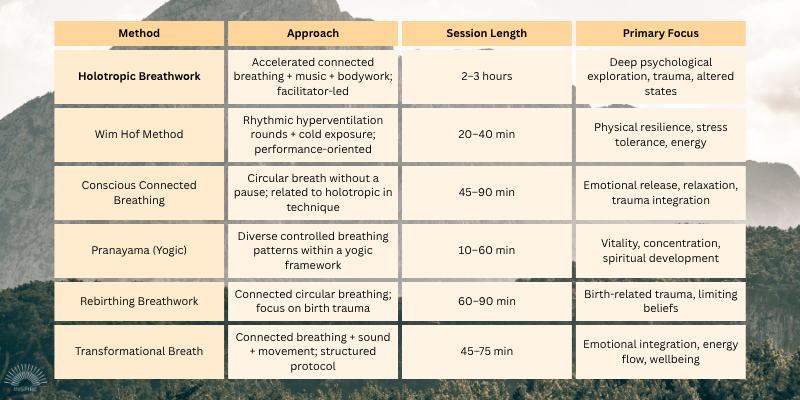
The key distinction that sets holotropic breathwork apart is its depth and duration, and the explicit intention to enter non-ordinary states of consciousness. It sits at the intensive end of the breathwork spectrum closer in spirit to psychedelic-assisted therapy than to everyday mindfulness practices.
Is There Scientific Evidence?
Honest engagement with the science requires acknowledging both what the research suggests and where it falls short.
The evidence base for holotropic breathwork specifically is limited in scale. As one Johns Hopkins psychiatry professor noted, research into the modality has historically been "minor, anecdotal, and not carried out at large institutions." There are relatively few large, randomised controlled trials, and many existing studies have methodological limitations such as small sample sizes and lack of control groups.
That said, the emerging picture is not empty:
What the Research Suggests
A small pilot study conducted in Denmark found increased self-awareness and improvements in temperament measures following multiple holotropic breathwork sessions, alongside a transient increase in paranoia in some participants.
A large clinical report documenting holotropic breathwork with over 11,000 psychiatric inpatients across twelve years found the procedure was well-received, with no adverse reactions recorded, and transpersonal experiences reported by 82% of participants.
A 2025 study published in Communications Psychology examining circular breathwork (which includes holotropic-style techniques) found that decreased CO₂ levels during the practice correlate with altered states of consciousness, providing physiological grounding for practitioners' reported experiences.
Research into broader breathwork practices shows associations with reduced anxiety, improved mood, and enhanced emotional regulation, with some studies finding significant reductions in PTSD and depression symptoms.
A Johns Hopkins research team has initiated a formal study examining holotropic breathwork's potential for veterans with PTSD marking a significant step toward institutional-level investigation.
The physiological mechanisms are better understood than the psychological ones. Rapid, sustained breathing lowers CO₂, alters blood chemistry, affects the limbic system, and creates conditions for emotional material to surface. How exactly this produces therapeutic outcomes — or how lasting those outcomes are requires much more rigorous study.
For now, the honest position is this: anecdotal and preliminary evidence is promising, rigorous evidence is sparse, and more research is genuinely needed. Anyone considering holotropic breathwork should approach it with curiosity and appropriate caution, not as a guaranteed cure, but as a practice with real potential that merits serious investigation.
Final Thoughts
Holotropic breathwork is not a wellness trend. It is a fifty-year-old practice with deep roots in transpersonal psychology, clinical observation, and the human need to explore what lies beneath the surface of ordinary consciousness.
It is not for everyone. It is not a substitute for therapy. It does not offer guaranteed outcomes. But for those who are drawn to it and who approach it with a good facilitator, honest preparation, and appropriate medical clearance, it can offer something that is increasingly rare: a structured, supported opportunity to turn inward, to meet one's own inner world with courage and curiosity, and to discover what the breath alone is capable of revealing.
At its heart, holotropic breathwork is an invitation into a deeper relationship with the body, the breath, the emotions, and the unconscious mind. What one does with that relationship, how one integrates, how one lives differently afterward, is the real work.
The breath is always there. The question is simply how far you are willing to follow it.
Looking to experience breathwork before committing to a professional training?
Tide Ritual is a six-week guided journey designed to support life transitions through conscious breathing, reflection, and community. or you can try Breathing Beyond Empire, which explores the cultural, historical, and social contexts that shape breathwork today, inviting practitioners to examine power, privilege, embodiment, and collective healing alongside their personal practice.
