Trauma-Informed vs. Trauma-Aware vs. Trauma-Specific: The Differences That Matter for Your Training Choice

Source: Islam Hassan
In this article
Why this terminology confusion exists
Trauma-aware: the foundation
Trauma-informed: the middle layer
Trauma-specific: the depth most programs skip
A side-by-side comparison
Questions to ask any training program
What this looks like at Inspire Breathwork
"Trauma-informed" has become one of the most overused words in the wellness industry. If you're choosing a breathwork facilitator training, understanding what it actually equips you to do and doesn't could be the difference between a program that prepares you and one that leaves you dangerously underprepared.
Why this terminology confusion exists
Walk through any breathwork training directory and you'll find the phrase "trauma-informed" attached to almost every program. It has become a marketing signal as much as a clinical descriptor and that's precisely the problem. Since breathwork facilitation remains an unregulated title, anyone can use the term regardless of what their training actually covers.
This matters enormously, because these three terms; trauma-aware, trauma-informed, and trauma-specific describe meaningfully different levels of capability. A program that teaches you to recognise trauma responses is not the same as one that teaches you to safely work with someone who is dissociating mid-session. Conflating the two doesn't just create false expectations. It can put both facilitator and breather at real risk.
Saying a course is trauma-informed without specifying what that actually means can create a false sense of safety for both the prospective facilitator and the people they'll eventually hold space for.
Trauma-aware: the foundation
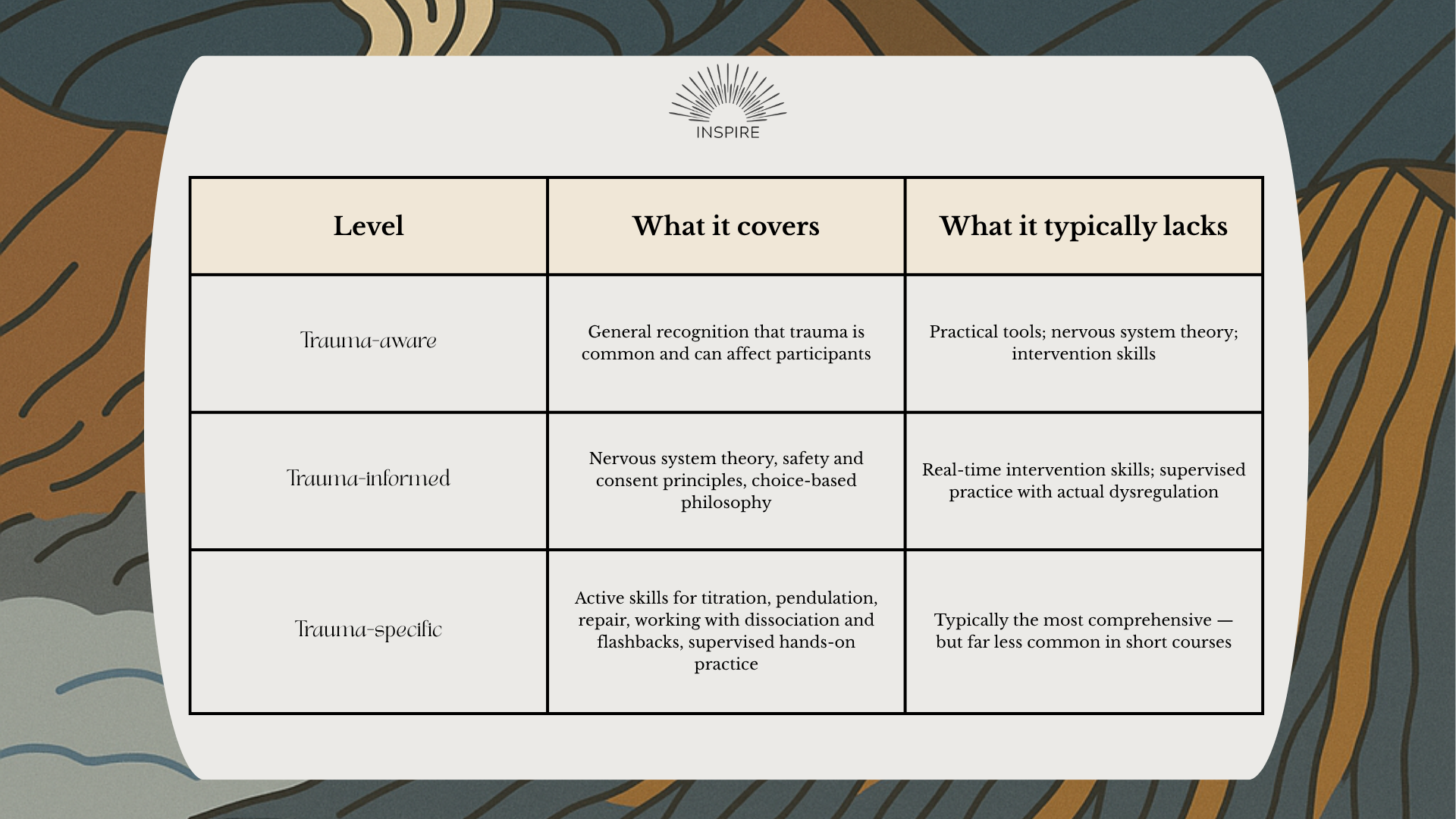
Trauma-aware is the most basic level. It means a facilitator has a general understanding that trauma exists, that it's common, and that it can shape how people show up in a session. A trauma-aware practitioner might know, in broad terms, that someone with a trauma history could become overwhelmed by an intense breathing pattern.
What trauma-aware training typically does not include is the practical skill set to actually work with that overwhelm in the moment. It's awareness without application - useful as a starting point, but insufficient on its own for anyone planning to facilitate sessions involving real emotional depth.
Trauma-informed: the middle layer
Trauma-informed goes further. It involves understanding how trauma lives in the nervous system. Not just as a story someone carries, but as an ongoing physiological pattern of protection. A trauma-informed facilitator understands concepts like the window of tolerance, the role of the vagus nerve in regulation, and why pushing someone toward catharsis can do more harm than good.
Practically, trauma-informed training tends to cover principles: safety and consent as a foundation, choice-based facilitation, grounding before and after sessions, and a non-judgemental stance toward whatever arises. These principles shape the philosophy of how a session is held.
What trauma-informed training often still lacks is the moment-to-moment skill of intervention, what to actually do, in real time, when someone's nervous system tips outside their capacity to stay present. Knowing the theory of dissociation is different from knowing how to gently bring someone back into their body when it's happening in front of you.
Trauma-specific: the depth most programs skip
Trauma-specific training is where theory becomes embodied skill. This level trains facilitators to actively recognise and respond to trauma responses as they unfold; tracking subtle physiological cues, knowing the difference between productive emotional movement and dysregulation, and having a concrete repertoire of techniques to titrate intensity, support pendulation between activation and calm, and repair the room if something goes sideways.
This is also where facilitators learn the architecture of consent in practice with checking in continuously, reading non-verbal cues, and knowing how to hold a session where someone has a flashback, a panic response, or a sudden shutdown. Trauma-specific training typically includes supervised practice: observing real sessions, practising under guidance, and receiving feedback before working independently.
A side-by-side comparison
Questions to ask any training program
Whichever school you're considering, these questions will tell you more than the word "trauma-informed" on the brochure ever could.
Before you enrol, ask;
Does the curriculum include nervous system theory (polyvagal theory, the window of tolerance) or just general awareness that trauma exists?
Will I observe real breathwork sessions, including ones where something difficult arises, before I facilitate independently?
Does the program teach specific techniques for titration and pendulation, or only the principle that "pacing matters"?
How does the training address consent and touch in practice? Is it a stated policy, or an embodied skill I'll practise and receive feedback on?
Will I be supervised while working with real participants before I'm expected to hold sessions alone?
Is the program accredited by a recognised body such as the UKBA, GPBA, or IBF, and does that accreditation specifically evaluate trauma-related training depth?
What happens, in the curriculum, when a session doesn't go to plan? Is repair and integration taught as explicitly as the breathing technique itself?
If a program can't answer these clearly, that's worth noting. It doesn't necessarily mean the training is unsafe, but it does mean you may be entering the field with awareness rather than skill, and clients deserve facilitators who have both.
What this looks like at Inspire Breathwork
Our facilitator training programme is built specifically to close the gap between trauma-informed theory and trauma-specific skill. Alongside coursework on nervous system regulation, embodied consent, and polyvagal theory, the training includes supervised observation of real sessions, hands-on supervised practice, and ongoing mentorship. So the skills are not just understood, but practised under guidance before you ever hold space alone.
This is also where our decolonial lens matters. Trauma, in our training, is understood in its full scope - personal, intergenerational, institutional, and historical rather than treated as an isolated individual event. A facilitator trained only in the basics of trauma-awareness may miss how systemic and ancestral trauma shows up differently than a single traumatic incident. Trauma-specific training, done well, accounts for this complexity.
Going deeper
2-Year Facilitator Training
Breathwork Facilitator Traiing, GPBA & UKBA Accredited
A trauma-specific, decolonial training programme combining workshops, supervised breathwork sessions, and 1-to-1 mentorship — designed to take you beyond awareness into embodied, practised skill.