
Live or Self-Paced? How to Choose the Right Breathwork Format for You

Source: Michael Olsen
In this article
What "live" and "self-paced" actually mean
What self-paced breathwork is good for
What live breathwork offers that recordings can't
A side-by-side comparison
Questions to ask yourself before choosing
Where to start
Not all breathwork sessions are created equal, and the format you choose matters more than you might think. Here's how to know whether a live, guided session or a self-paced recording is the right fit for where you are right now.
What "live" and "self-paced" actually mean
Breathwork is available in two broad formats. Self-paced sessions are pre-recorded with audio or video you can press play on whenever suits you, guided by a facilitator who isn't present with you in real time. Live sessions happen in real time, either one-to-one or in a group, with a facilitator who is actually watching, listening, and responding to you as the session unfolds, whether that's in person or via video call.
Both have real value. The right choice depends less on which is "better" in the abstract, and more on what you're working through, how much support you need, and where you are in your relationship with breathwork.
What self-paced breathwork is good for
Self-paced sessions are an excellent entry point and a reliable daily practice. They're available the moment you need them, repeatable as often as you like, and require no scheduling or coordination with anyone else.
They tend to work best for lighter regulation practices; extended exhale breathing, box breathing, simple diaphragmatic work, where the goal is calming the nervous system rather than processing something complex. If you've had some experience with breathwork already and know roughly what to expect from your own body, a recording can be a steady, low-stakes way to maintain a regular practice.
Self-paced breathwork is a wonderful daily companion. It is far more limited as a tool for working through something specific and significant.
The limitation becomes clear once something unexpected arises. A recording cannot see you. It cannot tell whether your breath pattern has shifted, whether you've gone somewhere emotionally intense, or whether you need to be gently brought back. If a strong memory surfaces, or your body responds in a way you didn't anticipate, you are navigating that entirely alone.
What live breathwork offers that recordings can't
A live facilitator, whether in the room with you or watching over video call is actively tracking your experience as it happens. They can see the rise and fall of your chest, notice if your breath becomes erratic or you appear to be struggling, and adjust the pacing of the session in real time. If something significant comes up, they can support you through it rather than leaving you to find your own way back.
This matters most for deeper work, particularly conscious connected breathwork, which can access the subconscious and surface material that talking therapies haven't reached. The depth that makes this kind of breathwork so powerful is also exactly why having a present, responsive guide matters. Live facilitation means consent can be checked continuously, intensity can be calibrated to you specifically, and you have someone to ask questions of, mid-session, if you need to.
Live group sessions add something further: a sense of shared presence, even at a distance. People joining the same session create a kind of collective container that a recording, however well made, cannot replicate.
A side-by-side comparison
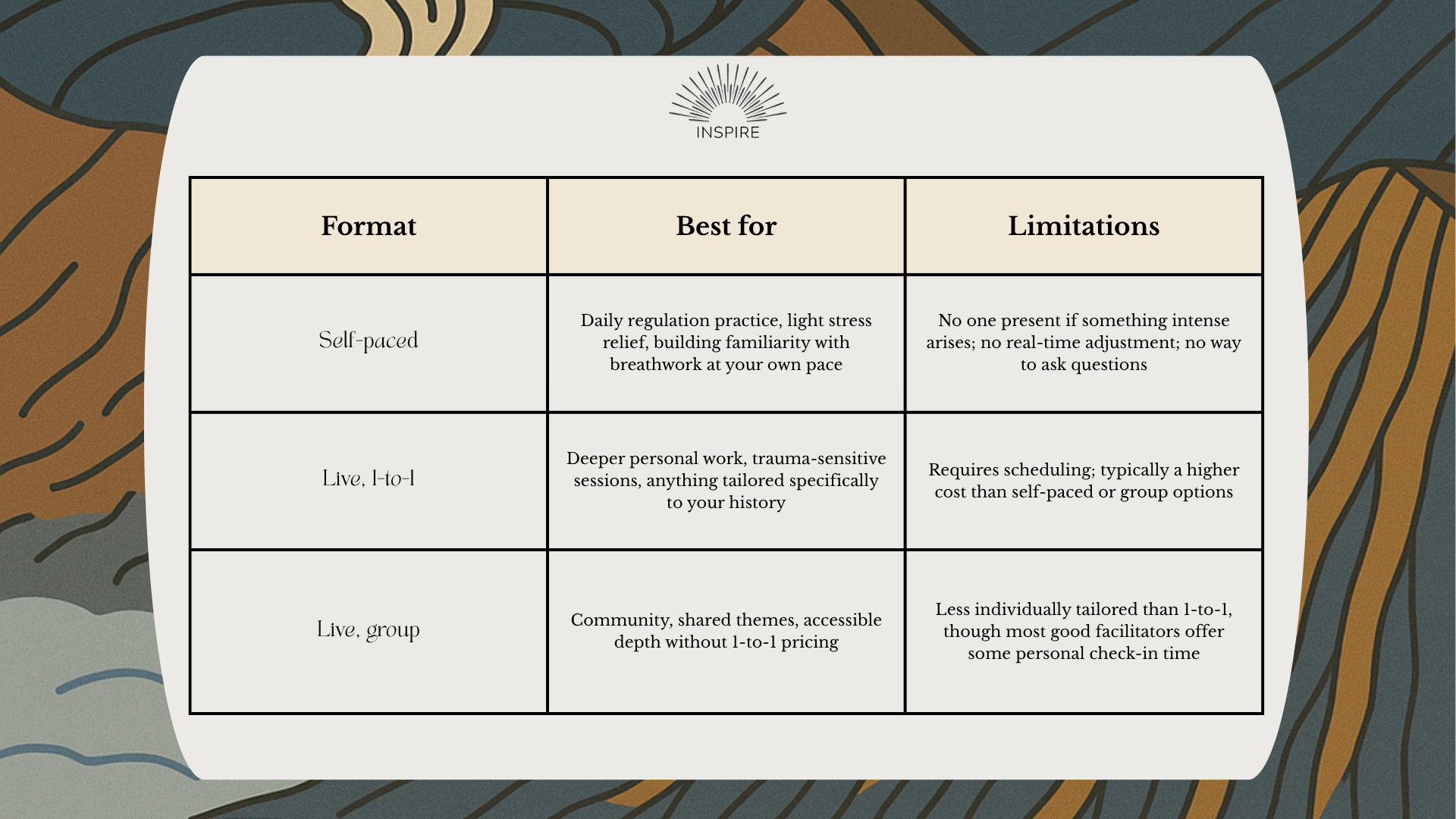
Questions to ask yourself before choosing
A quick self-check
Am I using breathwork for daily regulation, or to work through something specific?
Do I have a trauma history, or has breathwork brought up intense material for me before?
Would I feel supported knowing no one can see or respond to me if something unexpected comes up?
Am I drawn to community and shared experience, or do I want this to be entirely private and self-directed?
Is this my first time, or am I already familiar with how my body tends to respond to breathwork?
If your answers lean toward "something specific," "trauma history," or "first time going deeper" live, guided breathwork is almost always the safer and more supportive choice. If you're maintaining a practice you're already comfortable with, self-paced sessions can serve you well between live experiences.
Where to start
If you're new to live breathwork, the lowest-commitment way to find out what it feels like is a free guided session - no booking pressure, just an experience of what live facilitation actually offers. From there, our 6-week live courses go deeper, with a community moving through the work together.
Live courses & sessions
The Tide Ritual
For those navigating change; career, relationship, identity, loss. Weekly live sessions, daily audio breathwork, and a community holding the transition together.
£150 · Online via Zoom
Breathing Beyond Empire
A gentle but honest journey into how colonial values live in the body; and how to begin releasing them, live and in community.
Sep 16 – Oct 21, 2026 · Online via Zoom
Not ready for a course yet? Start with a free guided breathwork
