
Your Nervous System Remembers What You Were Never Told
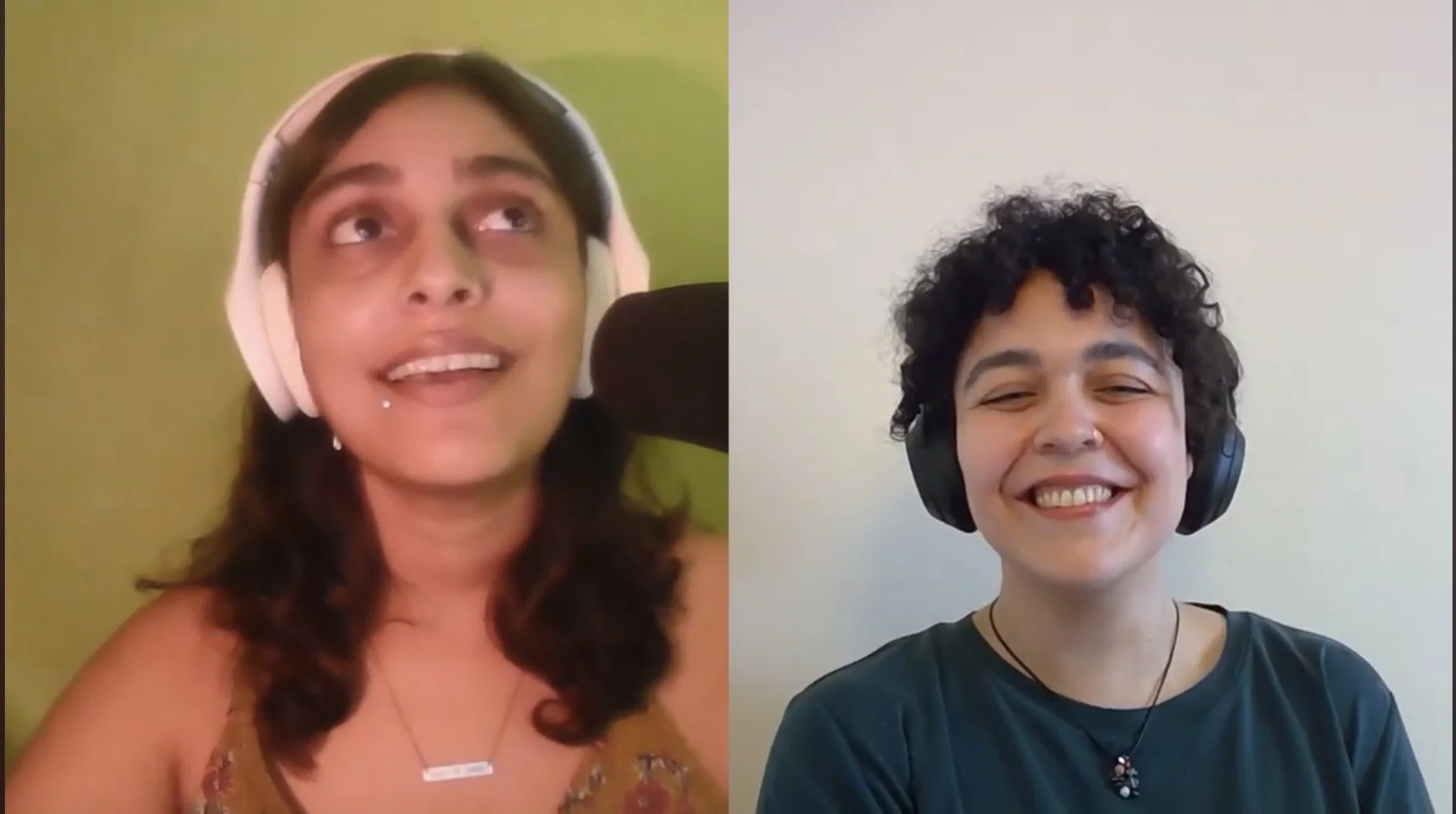
Image Source: Inspire Breathwork Podcast on YouTube
A listener's reflection on Episode 3 of the Inspire Breathwork Podcast, with Kaydee
Kaydee can trace part of her lineage back to a single village in Ireland, once renamed after a queen who claimed the county as her own. Stolen language. Forced starvation. A history close enough that when she wakes up and checks the news on an ordinary Thursday, what she feels isn't distance. It's rage.
What stands out most, listening to her talk about this, is how precisely she locates that rage in her actual body. Not as metaphor. As heat, spreading, the same activation she'd feel as prey scanning for a threat. She traces it straight back to epigenetics, to the plain fact that we carry our ancestors' stories with us, encoded in which parts of our biology get switched on and which get suppressed, passed down like instructions for how to survive whatever comes next.
That reframes something most of us have been taught to see as a personal malfunction. Hypervigilance, a tightness in the chest that won't leave, isn't a glitch in the system. It's an heirloom. Somewhere in your lineage, staying on guard was the only thing that kept the family alive.
Kaydee's own connection to her lineage is fragmented in a way that took her years to make peace with. Both her parents were mixed race, born into families where that fact carried shame, both eventually placed with relatives who couldn't fully hold them. She grew up unable to name where exactly she belonged in the picture, sitting at tables with her stepfather's white family, feeling the difference without having language for it. The tools she'd find online, build an altar to your ancestors, create ritual around your lineage, assumed a connection she'd never had access to. What she found instead was something less tidy and, I think, more honest: a sense of fortitude she can feel in her bones and her gut, a certainty that if her ancestors survived forced starvation and still found joy on the other side of it, that capacity is somewhere in her too, even without a name attached to it.
Her clearest language is for disembodiment itself, and this is where the episode gets genuinely useful, beyond the theory. She describes interoception, the ordinary signals a body sends about hunger, thirst, danger, and what happens when a child grows up in an environment where those signals can't be acted on. Fear registers, but there's nowhere to take it, no way to leave the situation or advocate for yourself. So the signal stops being picked up until it's already at its most extreme. That's the mechanism underneath a lot of what gets labeled emotional overreaction. Not a broken alarm system. A perfectly logical adaptation to a childhood where the alarm was never allowed to matter.
She names something else too, quietly devastating in how simple it is. That she'd been disembodied for essentially her entire life until she became pregnant, and that even then, what she was tuning into wasn't her own body. It was her baby's needs, communicated through her body. Coming home to yourself, the language the wellness world uses so freely, assumes home is a place that already feels safe. For a lot of people, she says, the body is a battle zone first. Coming into it means meeting scars you haven't yet made sense of, and that's a much harder, slower thing than the romanticized version suggests.
It's hard to shake how she describes the year she and her daughter became homeless, living in temporary accommodation in the UK. She'd always taken a certain pride in the safety net, the NHS, social housing, the idea that a country could catch you before you hit the street. What she found inside that system was a level of dehumanization that ran in both directions. Families crowded into single rooms, advocating for themselves and getting nowhere, and on the other side of the desk, caseworkers capped on how much help they were allowed to give before being pulled into a manager's office for going too far. Nobody in that exchange, she says, could stay connected to their own humanity and still do the job in front of them. The dissociation wasn't a personal failing on either side. It was what the structure required to keep functioning at all.
That's close to the sharpest thing she says all conversation, something she credits to Hannah, from the training they're both part of. We cannot find the cure, or even correctly name the medicine, until we can acknowledge that we are the poison. Not one villain to isolate and blame. All of us, collectively, still metabolizing the same system.
Intuition comes up late in the episode, and Kaydee draws a distinction worth sitting with. She doesn't think intuition itself ever really misleads anyone. What gets mistaken for intuition is often just conditioning, a lifetime of learning to prioritize external approval over an internal signal, dressed up as instinct. The real question isn't whether to trust your gut. It's whether what you're calling your gut is actually yours, or a survival pattern so old it's stopped feeling like a pattern at all. Untangling the two, she says, is most of the actual work.
Motherhood, for her, was a rupture point. Not a soft awakening, an existential crisis in the most literal sense, identity stripped down to almost nothing and rebuilt around a question she'd never had to answer honestly before: what do I actually value, once no one's watching to grade it. She talks about returning from maternity leave, still chasing a career path she'd mapped out years earlier, and realizing that she no longer recognized the hunger for 'success' as her own. What replaced it wasn't clarity exactly. It was closer to permission, to build the answer instead of inheriting it.
The episode closes with something worth carrying afterward. Asked what she'd send back to her ancestors through her own breath, and what she'd send forward to her daughter, her answer wasn't a resolution. It was forgiveness, offered plainly, to women in her lineage who passed down harm they likely never chose consciously, alongside grace for herself, a woman her own daughter seeks unwavering certainty from, when she's still working out the steps as she takes them. Healing, in her account, was never going to be a straight line back to safety. It's closer to getting comfortable with sitting with the mess long enough to see the rich tapestry emerge.
You can hear the full conversation between Suks and Kaydee, including a closing performance of Scar's poem "I was not raised by soft women," in Episode 3: Bodies of History: Trauma, Nervous Systems, & Ancestry (The Grounding), on the Inspire Breathwork Podcast. You can find Kaydee's work on Instagram at @homebody.archive.
If this is a thread you want to keep pulling, Breathing Beyond Empire goes further into it, through breath, embodiment, and collective healing.

