
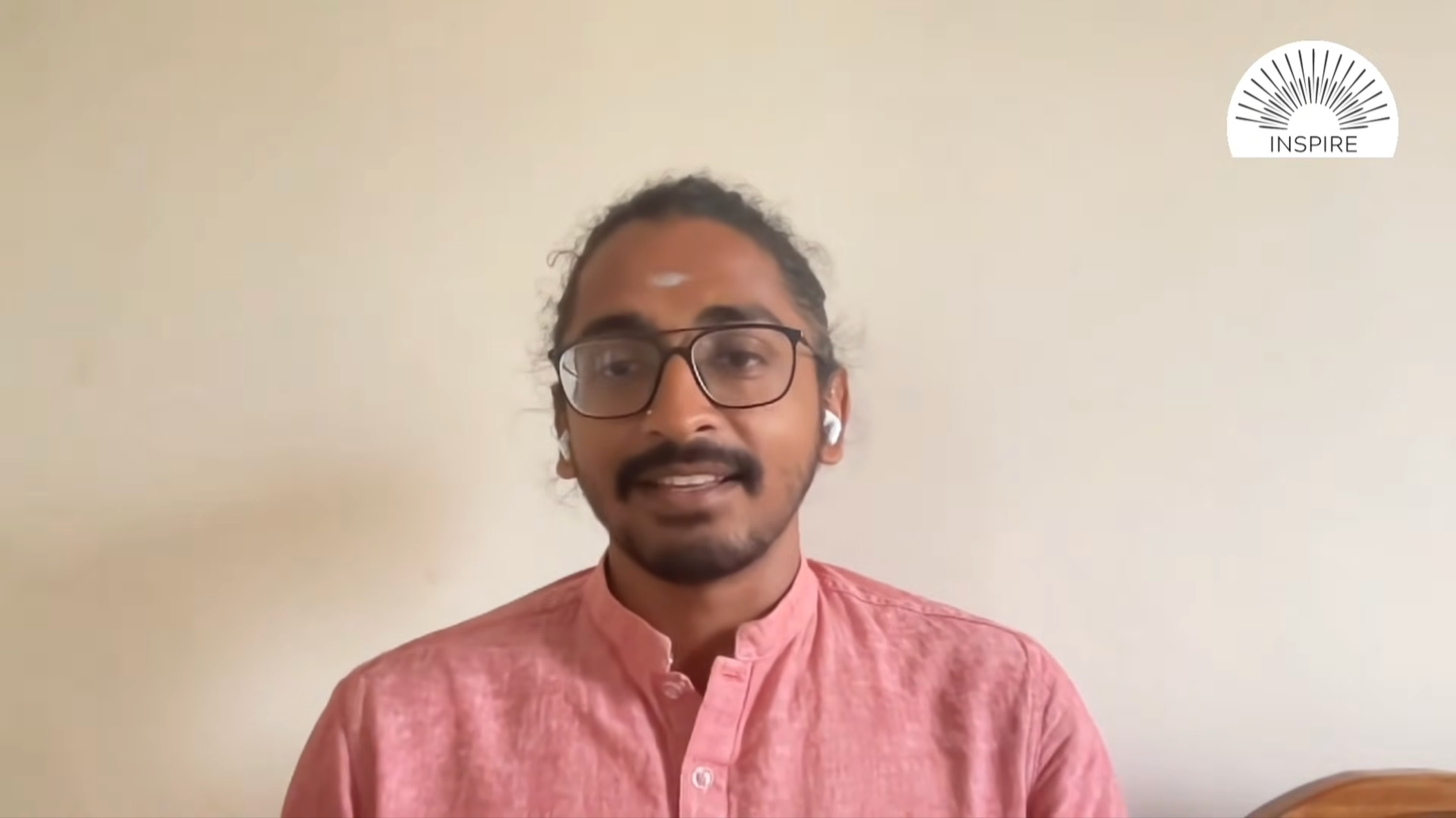
Image Source: Inspire Breathwork Podcast
Notes from a conversation with Vinay Swaminathan on discernment, space holding and grace
There is a stage in many breathwork journeys where the collecting begins. One more training, one more technique, one more certificate, each promising to be the thing that finally makes you ready. In Episode 9 of the Inspire Breathwork podcast, host Suks sits down with Vinay Swaminathan, a healer and breathwork guide, to ask what happens when you stop collecting and start standing in your own path.
Vinay's work centres on welcoming all of life: the beautiful, the mundane, the difficult and the unknown. He wants to grow our capacity to stay open, connected and responsive through all of it. He believes there is a genius within each person, and that the work is to create the inner and outer conditions for it to blossom. Technique and certification matter less to him than how much a person is willing to live and embody their own healing.
I keep returning to the word "genius" here. It shifts who holds the authority in the room. If the genius already lives in the person breathing, then a facilitator's job gets quieter and more humble. It becomes a matter of tending the conditions. That is a very different relationship to expertise, and it asks a lot of the one holding space.
That belief shapes how he holds space. The conversation moves through discernment, the quiet skill of knowing what a moment is asking for, and through the relief of letting go of spiritual "special effects". When a session no longer needs a show, presence is what remains. Suks and Vinay speak the way two space holders do when they share the same unspoken language, and you can hear the recognition between them.
To me, discernment is the part that cannot be collected. A technique can be learned in a weekend. Reading a moment, and knowing whether it wants action or stillness, grows through practice and through your own honesty about your motives. And the relief around "special effects" makes sense to me. Effects can be a way of managing our own nerves, proving that something is happening. Letting them go means trusting that presence is enough, and that is harder than it sounds.
Vinay talks about holotropic breathwork as his way towards wholeness. He describes how growing consciousness moved him away from idolising himself and away from living unconsciously, and towards loving himself.
What I find interesting is that he places two opposite habits side by side. Idolising ourselves and living unconsciously can look like very different ways of being, yet both keep us from seeing ourselves clearly. Consciousness, as he describes it, sits in the middle, and the thing waiting there is self-love. It suggests that awareness only heals when it is kind.
He also tells the story of his own transformation. It began when he recognised the trauma he had faced and saw that he had played a part in it too. Healing from that brought him a measure of freedom. Along the way, the conversation returns to how childhood patterns keep speaking through the body, long after we think we have moved on.
I read this as an invitation to hold two truths at once. We can be shaped by things done to us, and we can also see how we carried those patterns forward. Seeing our own part returns some agency, and agency is where freedom tends to start. The body keeps the record, which may be why understanding alone rarely finishes the work.
For Vinay, healing has to be lived in the body. Understanding a process is a start, and embodying it is what opens the way to being truly healed. It is also why he can hold a space that is safe enough to go deep, coherent enough to trust and strong enough to hold what unfolds.
That suggests a test for any space we step into, whether we are facilitating or being facilitated: does the person leading live what they offer? Perfection is not the bar. A willingness to keep doing their own work is. Integrity in this field seems to come from that continuing.
The episode turns, too, to the intelligence of the collective field, and the primal wisdom in trusting it. It is a reminder that healing was never meant to happen alone.
I think this is the counterweight to so much wellness language about the individual. If the field itself holds intelligence, then we are part of each other's healing, and a good space is something made together. It also takes some pressure off a facilitator, who no longer has to be the sole source of everything.
Near the end, host and guest share a few honest moments. Vinay gives thanks to Inspire Breathwork and to Hannah, and he says what builds trust for him is a willingness to bring the difficult things into the open and work through them together. He thanks himself for showing up, too. He had felt resistance, listened to his body's instinct to let the other person lead the communication, and found a mix of shock and good feeling in what had just happened.
Both moments stay with me. Trust built on a willingness to name the hard thing is sturdier than trust built on never having friction, because it comes with a way back. And thanking yourself for showing up, through resistance, treats resistance as information instead of failure. The body's instinct to wait turned out to be wise, and he honoured it.
Suks closes with a poem by Subramanya Bharati, a Tamil poet and freedom fighter from early twentieth-century South India. The British authorities thought him dangerous enough to send into exile, and he kept writing anyway. His poem "The Jewel of Stars" imagines a mind let free to roam, and a bee inside a fruit it has found. Suks ties it to the kind of breathwork Vinay practises, one that does not prescribe, rush or bypass, and leaves room for presence.
The image works on me because a bee does not need instructions to find something sweet. It goes where its nature leads. Placed next to the earlier talk of collecting and special effects, it asks a gentle question: what would you follow if no one handed you a method?
She leaves listeners with a thought worth keeping. The difficult years are not wasted, and what we survive can become, in time, the very thing we offer. Somewhere underneath everything that was handed to you, there is still a bee looking for its fruit. In her words: "find your bee, rest in its grace and let it sing."
Listen to Episode 9: (Episode 9) From Technique to Wholeness: Discernment, Space Holding, and Grace
Connect with Vinay: vinayswaminathan.com
