
Acceptance Is Not Surrender. It's the Hardest Active Thing You Can Do.
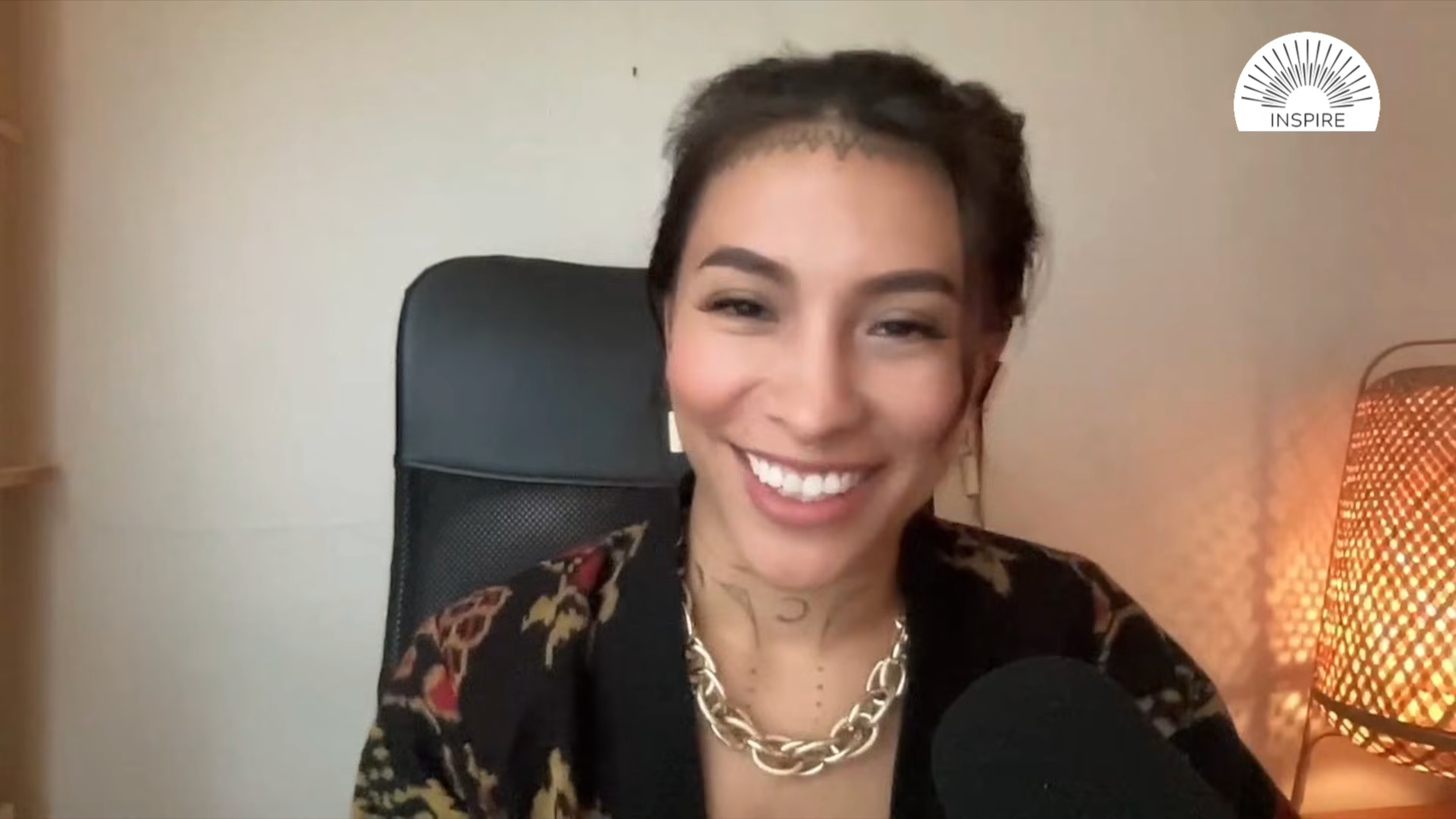
Image source: Inspire Breathwork Podcast
A listener's reflection on Episode 8 of the Inspire Breathwork Podcast, with Hannah Kendaru
This episode is a little different, since it's Hannah herself in the guest chair this time, seven months into a podcast built on the container she created, with Suks stepping into the role of host to ask the questions. Suks opens by asking something disarmingly ordinary. Not the vision, not the work, just the texture of an ordinary day. Tea, biscuits, a garden she's been roped into re-landscaping in London, more birds and foxes than she sees at home in Bandung. It's a good way in, because it makes what comes after land differently, all of this thinking comes from an actual, particular, tired-sometimes body, not a theory floating above one.
Asked plainly what the world is asking of us right now that we might not be equipped to answer, Hannah goes somewhere I didn't expect. Not urgency. Acceptance. She calls it the first lesson of breath itself, and she's careful to name the misconception baked into that word. Acceptance sounds passive, like surrender, like giving up on wanting things to be different. She argues the opposite. Taking a full inhale, all the pollutants, the smoke, the weight of what's actually happening, and choosing to let it in rather than flinch away from it, is genuinely hard, active work. We survive by breathing shallow instead. We dissociate. We take in only the version of reality we can currently stomach. Learning to take the whole breath, the whole picture, is the actual practice.
She says something here that I keep turning over. Any crisis attended to with urgency becomes a crisis in its own right. That's a strange thing to hear from someone building a course, a school, a whole movement. It would be easier to sell speed. Instead she's arguing for slowness as the more honest response, even though she knows how disappointing that sounds when what people want is a plan.
What struck me most was her answer about self-doubt. She doesn't deny that human minds naturally assess risk, or that some baseline insecurity is just part of being a person. But she's precise about what's manufactured versus what isn't. We compare ourselves to a dominant identity, neurotypical, wealthy, educated, able-bodied, safe, and the doubt that comes from falling short of that comparison isn't really about us. It's supremacy culture doing exactly what it's designed to do. She admits this is one of the griefier realizations in the work. Discovering you've spent years measuring yourself against values that were never actually yours to begin with.
That thread runs straight into her thinking on AI, which is the part of this conversation I think people will be talking about longest. She calls it, plainly, the colonizer's favorite child. Not an insult aimed at the technology itself, but a description of what it embodies almost perfectly, performance, certainty, rationality, quantity over quality, one right answer. All characteristics of supremacy culture, rewarded and reinforced because we've been trained to value exactly those things for a long time already. When we start comparing ourselves to AI and feeling like we're losing, she suggests we're not really being out-competed by a machine. We're being shown, very clearly, what we'd already been conditioned to chase.
She ties this to something quieter and, I think, more useful than a critique of technology. Urgency and speed have a cost, and the first thing that falls off the table when we're rushing is care. That's true of how we treat AI-generated shortcuts, and it's true of how communities fracture under pressure. Slowness isn't a luxury in her framing. It's the precondition for actually attending to anything, or anyone, properly.
There's a bigger claim underneath all of it that I want to sit with a while longer. If it's present in the social body, it's present in our body. The way we treat the planet is rooted in how we treat people, which is rooted in how we treat ourselves, which is rooted in how we treat the parts of ourselves we've been taught to shun. Extraction isn't just something that happens to forests and rivers. It's a pattern we've learned to run on our own nervous systems too.
Toward the end, she brings in a concept from Avi Sakata-Pulo's work that she's been sitting with for over a year, traumatophilia, a trauma-loving stance, as opposed to being trauma-phobic, flinching from any sign of activation as if it's an emergency to be calmed immediately. She's honest that most trauma-informed practice, including breathwork, is built to help people regulate and find their way around big emotion rather than through it. The idea of welcoming overwhelm on purpose, gently, inside a held container, as a way of cracking something rigid open, felt like a genuinely different proposition than the caution most healing spaces default to.
All of this is the backdrop for Breathing Beyond Empire, the course she's opening applications for as this episode airs. She traces its roots back to 2020, to an earlier initiative she ran called the Forest Garden, and more directly to the work of Tema Okun, who compiled an open-source list of the characteristics of supremacy culture that Hannah and her community have spent years working through one by one. What she's built from that isn't an abstract critique. It's structured as an embodied experience, breathing through each characteristic, feeling where it lives in the body, and actively practicing something different in its place.
She's careful to name what the course is and isn't trying to do. A lot of social justice work, she says, ends up trying to position itself as the good side, uncontaminated by the systems it's fighting. Breathing Beyond Empire starts from the opposite premise, that we all carry the coloniser and the colonised, the oppressor and the oppressed, inside the same body at the same time, and that real change asks us to take accountability for our own participation rather than standing outside it pointing elsewhere.
Structurally, it runs 21 days, with four live sessions and a daily guided audio practice delivered throughout, plus recordings to revisit afterward at your own pace. It moves through three areas in turn: safety, building resilience against manufactured fear, and finally the relationship to AI covered earlier in this conversation, what it means to stay human and resist the pull toward certainty and perfection inside a world that increasingly rewards exactly that. Underneath all three, she keeps returning to the same principle, that dismantling old patterns and re-indigenizing, remembering, and reconnecting have to happen together. Doing only one, she says, tends to leave people either stuck examining wreckage or spiritually bypassing the systems still shaping them.
Near the end, she names something worth remembering if any of this has ever made you feel like you're going through it alone. People drawn to decolonial healing are dispersed on purpose, because everywhere needs it in different ways, and that dispersal can make the work genuinely isolating, more isolating the further it moves you from what's considered normal around you. Finding each other, she says, isn't optional. It's how any of this survives being done by one person alone.
The episode closes with Suks reading Jane Hirshfield's poem "Optimism," resilience not as a pillow bouncing back to the same shape, but as a tree turning toward whatever light it can still reach when one side goes dark. It's a fitting note to end a season on. Not a promise that things resolve. Just an invitation to keep turning toward the light by whatever route is actually available, rather than the one you'd originally planned.
You can hear the full conversation between Suks and Hannah Kendaru, including the closing reading of Jane Hirshfield's poem "Optimism," in Episode 8 of the Inspire Breathwork Podcast.
If what Hannah shares here resonates, Breathing Beyond Empire opens for applications now, running September 16th through 21st.
More conversations like this one live at inspire-breathwork.org.

